
Cold Storage on Boat: Engineering Marine Cold Storage for Fishing Vessels
Marine cold storage systems are engineered for harsh sea conditions. This guide explains cold storage on boat design and cold storage room on fishing boat applications.
BANANA RIPENING ROOM
1/12/20262 min read
What This Page Focuses On
This page explains how cold storage on boat differs fundamentally from land-based cold rooms.
It is written for fishing fleet operators, marine engineers, and cold chain project managers evaluating cold storage room on fishing boat solutions under real offshore conditions.
Why Marine Cold Storage Is Not the Same as Land-Based Cold Rooms
Marine environments impose constraints that do not exist on land.
Unlike warehouse cold rooms, marine cold storage must operate under:
Constant vibration and vessel movement
Limited installation space
Saltwater corrosion exposure
Variable power supply from generators
Continuous operation during long fishing trips
These factors redefine refrigeration design priorities.
Working Principle of Cold Storage on Fishing Boats
The refrigeration principle remains vapor-compression–based, but marine execution is adapted for motion and redundancy.
Marine cold storage systems prioritize stable cooling under fluctuating load, ensuring fish temperature is rapidly reduced after catch and maintained throughout the voyage.
Airflow is typically optimized for compact chambers to ensure uniform cooling without excessive fan power consumption.
Core Features Required for Marine Cold Storage
Effective marine cold storage systems focus on durability and reliability rather than maximum capacity.
Marine-grade compressors and electrical components
Anti-corrosion coated evaporators and condensers
Compact modular design for tight engine-room layouts
Shock-resistant mounting structures
Continuous-duty refrigeration capability
hengliangcooling applies these principles when designing cold storage systems for fishing vessels operating in both coastal and offshore conditions.
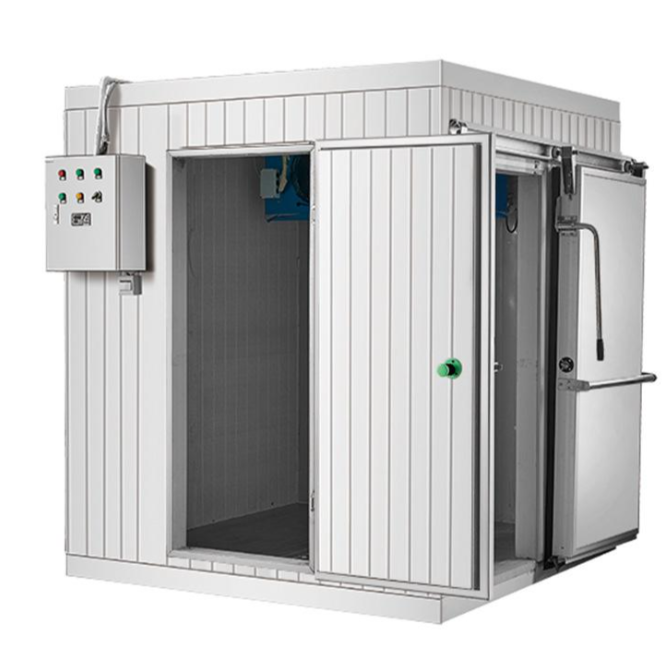
Typical Configuration of a Cold Storage Room on Fishing Boat
A standard fishing vessel cold storage system includes:
High-density insulated panels with moisture-resistant core
Compact refrigeration unit (often water-cooled)
Stainless steel or aluminum interior lining
Drainage system for meltwater and washdown
Digital temperature controller with marine-certified components
Configuration depends on vessel size, trip duration, and target catch species.
Key Engineering Difference: Marine Cold Storage vs Land-Based Cold Rooms
Before selecting equipment, buyers must understand why marine cold storage requires different engineering decisions.
The following comparison highlights the fundamental differences that affect reliability and lifecycle cost.
FAQ: Marine Cold Storage Systems
What temperature is used for fish storage on boats
Most fish are stored between 0°C and +2°C to slow spoilage without freezing.
Are marine cold rooms more expensive than land-based systems
Yes. Marine-grade materials, compact design, and corrosion protection increase system cost.
Can land-based cold rooms be used on boats
No. Standard cold rooms lack vibration resistance and corrosion protection required for marine use.
Professional Call to Action
Selecting a marine cold storage system requires understanding both refrigeration engineering and marine operating conditions. hengliangcooling supports fishing and marine projects by providing customized cold storage solutions, integrated system design, and reliable execution for harsh offshore environments.
Contact hengliangcooling to discuss technical requirements for your marine cold storage project.
HENGLIANG COOLING
We design, manufacture, and deliver integrated refrigeration solutions, including cold rooms, ripening room systems, and industrial chillers for global commercial and industrial applications.
SERVICES
Request a Customized Solution
© 2002-2026. All rights reserved.
Address
Xiamen, Fujian, China
Contacts
+86 18350573206
alan@xhllq.com